Sculptor, 1816-1863
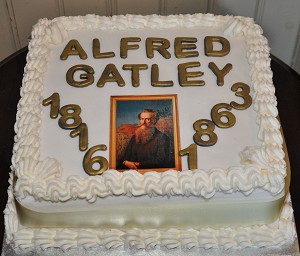
The 200th anniversary of the birth of Alfred Gatley was celebrated on Friday 15th January 2016. A ceremony was held at his birthplace at Spring House in Kerridge, when a Blue Plaque was unveiled to his memory.
|
Alfred Gatley was born at Spring Cottage (today known as Spring House), Kerridge, on 15th January 1816. His father owned and worked two stone quarries in Kerridge Hill. Alfred showed very early promise as a sculptor and took this up professionally. He spent much of his career in Rome, Italy, carving in marble. He died on 28th June 1863 at age 47, in Rome, where he is buried. There are many examples of his works in Bollington and the Cheshire and Manchester/Salford area as well as more widely. While the whereabouts of many of those pieces in private ownership were known in the 1960s I suspect that the passage of time will have resulted in some of them being widely distributed and beyond normal search. The late Dr John Coope used examples of Gatley’s work in the displays for the very first of his Bollington Festivals, in September 1964, and in preparation he and Harry Cole did a lot of research into Gatley with a view to writing a biography. Unfortunately the book never materialised but all Dr John’s papers and pictures were most generously donated by his widow, the late Dr Jean Coope, to Bollington Civic Society and they provide the basis of this page. The 200th anniversary of Alfred Gatley’s birth was celebrated by the unveiling of a Blue Plaque on his birth place, Spring House in Kerridge. WorksThis is a very incomplete list of Alfred Gatley’s works, the first part compiled by Dr John Coope and Harry Cole for the 1964 Bollington Festival. The details given are the subject, date of execution, last known location.
The following list is taken from a list of exhibitors at the Royal Academy in 1854. The whereabouts of all except one of these is unknown.
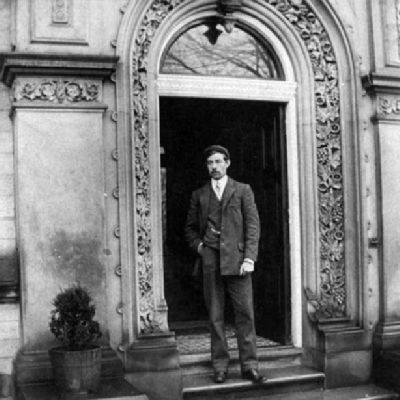
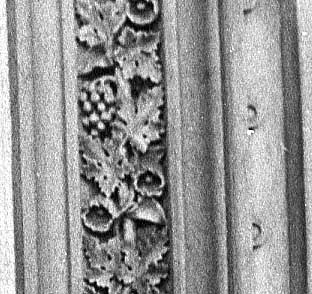
* The Hon. Augustus H Vernon was a member of the Poynton Vernon coal mining family. Other works by Gatley are, or were in recent years, at Lyme Hall; Salford City Art Gallery; St Mary’s Church, Disley; Mottram in Longdendale church. The two bas relief panels known as the Craigentinny Marbles (above right) were described at the time of installation in 1867 as “The most remarkable pieces of sculpture executed during this century.” The original Oak Bank House in Bollington, erected in 1858, had a very fine carved front door surround and frieze (picture right). Dr John Coope believed that this may have been the work of Gatley. Sadly this fine piece was lost when the house was demolished in the 1940s. Alfred Gatley’s 200th birthday was celebrated by the unveiling of a blue plaque (see above right) and the guests were refreshed at the Bull’s Head with coffee and a delicious cream and sponge cake baked and supremely decorated by Paul from Belfield’s Bakery in Palmerston Street.
|
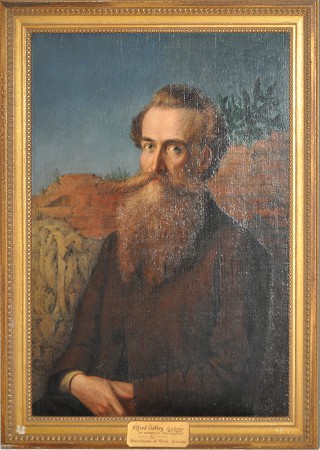 Alfred Gatley, 1816-1863, Sculptor Alfred Gatley, 1816-1863, Sculptor by Marcianno da Tuna, Rome 1862 Shown by the very kind permission of the late Mr Timothy & Mrs Elizabeth Richards of Gawsworth Hall  where the painting and other Gatley artefacts can be seen during house tours. 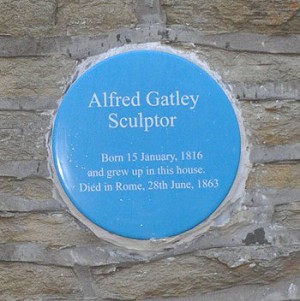 Blue plaque unveiled at his birthplace Blue plaque unveiled at his birthplaceon the 200th anniversary of his birth. 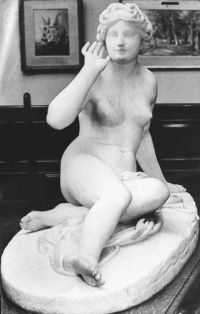 Echo – popular girl! Echo – popular girl!Gatley is known to have carved three of these! This one is on view at Gawsworth Hall. 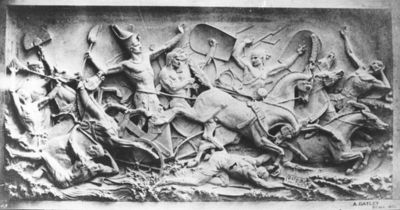 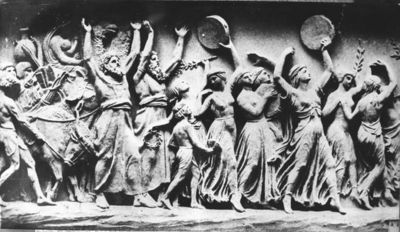 Two bas relief panels known as the Craigentinny Marbles Two bas relief panels known as the Craigentinny Marbles
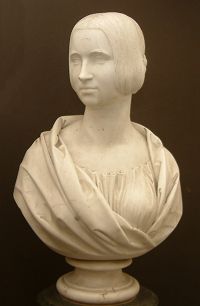
George Swindells and his wife Elizabeth Swindells
Oak Bank House front door surround (this is not Alfred Gatley standing there!). What a pity that the photograph didn’t include the whole of the door casing. Detail from the picture above.
|
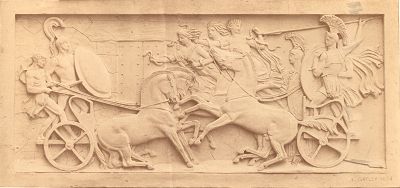 Revenge of Achilles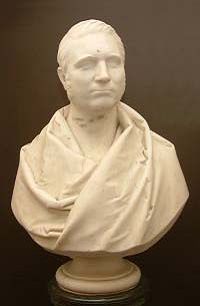
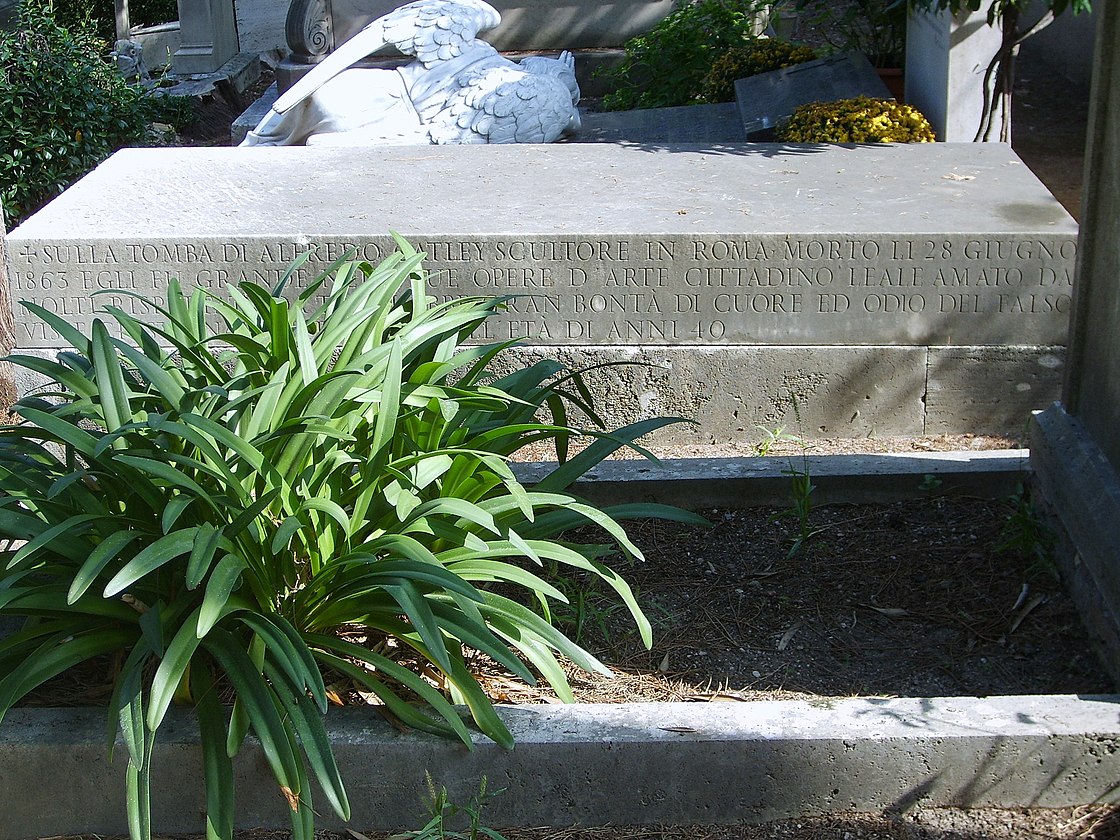
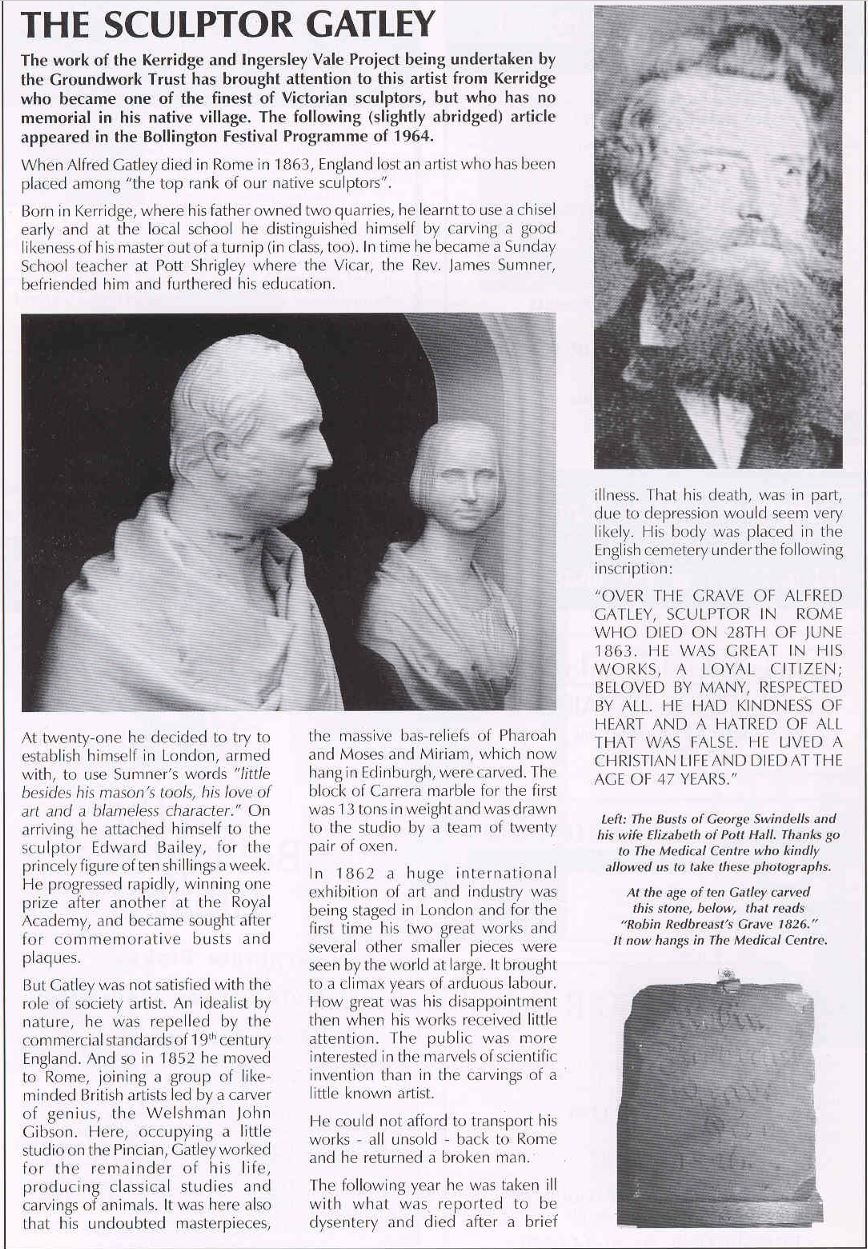
Extract from KRIV report by George Longden1William Broster asserts that Alfred Gatley was born in “the family home”, Gatley’s Yard – though it has to be said that Broster is not very reliable on historical matters outside his own experience [27]. According to the Dictionary of National Biography (DNB) [47], “while still a child [Gatley] learned the use of a stonemason’s tools from his father, who owned and worked two quarries in the Kerridge hills.” Alfred was educated at Rainow School where, tradition says, he carved his first work, his teacher’s head, out of a turnip [35, p.74]. Here, his ability, both artistic and general, was observed by the Rev. J. Sumner, the vicar of Pott Shrigley, who seems to have given him some private tuition alongside his own children [51]. After school he assisted in the family quarry, and here what Broster says was his first sculpture in stone, a figure of Walter Scott’s Tam O’Shanter, was completed. This work came into the possession of the Rev. Sumner, who loaned it in 1839 to an exhibition organised by the Macclesfield Useful Knowledge Society in Macclesfield Town Hall [16, 29 June 1839]. Two years earlier, in 1837, Gatley had moved to London, “aided by a few friends” as the DNB puts it. He worked in the studio of Edward Hodges Baily RA FRS, until in 1843 he became assistant to Musgrave L. Watson. In his early years in London Gatley studied in the British Museum, and then became a student of the Royal Academy, exhibiting there for the first time in 1841. Among works Gatley sold in his London period were figures of Cupid and Psyche, for Martin Swindells of Bollington, the memorial for the jubilee in 1846 of the Macclesfield Sunday School in Roe Street, and a bust of Dr. Sumner, archbishop of Canterbury and brother of the vicar of Pott Shrigley. The bust of Sumner was exhibited at the Royal Academy in 1848, and at the same time a cast of it was on display in Macclesfield Town Hall. The Macclesfield Courier commented that “the success of this rising young artist has been almost without parallel” [16, 15 July 1848]. In spite of a growing reputation, Gatley remained in tight financial circumstances. In 1852 he moved to Rome, where he took a studio on the Pincian Hill. Here, he still struggled to find adequate patronage, as his letters home show. In 1860 the Rev Sumner wrote to Gatley, mentioning an old acquaintance with artistic ambitions; Gatley replied “I certainly pity him if he does not pocket 10 times per annum more than I do” [48]. Gatley’s letters, incidentally, also suggest complex (and contested) Gatley family properties and finances in Kerridge. Gatley exhibited his bas-relief of ‘Pharaoh and his Hosts’ at the International Exhibition in London in 1862. This was to be the occasion of Gatley’s last visit to England; he died from dysentery in Rome on 28 June 1863, and is buried in the English cemetery there (picture above right). The rumour that he was poisoned by jealous Italian sculptors was prevalent in Kerridge for many years. An obituary for Gatley appeared in the Art Journal: “He had a mind of singular independence. The style he chose admitted of no facile compromise of the classic with the pictorial. It descended not to seek an easily purchased popularity by softly blended forms after the manner of the Romantics. The school to which he belonged was stern and strict. The English public failed to comprehend the largeness of his manner” [57]. Alfred Gatley’s diary and letter books and desk, a portrait of Gatley painted in Rome in 1862, a bust of Milton in Kerridge stone (1833), a reclining figure of a young girl, ‘Echo’ (1850), and a bas-relief panel ‘The Triumph of Britannia’, all by Gatley, are listed in Raymond Richards’ Manor of Gawsworth (1974 edition) as being in the Gawsworth Hall collection [49]. ‘Echo’ is illustrated in Richards’ book, as it is in the brochure for the first Bollington Festival in 1964, which also contains a photograph of Gatley, impressively wild in hair, beard and eye [50]. Other works by Gatley are (or were recently) at Lyme Hall; Salford City Art Gallery; St Mary’s Church, Disley; Mottram in Longdendale Church; and Bollington Medical Centre [58]. William Broster, it seems to me, made a good point when he wrote that “it is unfortunate and regrettable that nothing in [Gatley’s] native village remains to perpetuate his memory and outstanding eminence as a sculptor of national fame in the Victorian era” [27]. We have put right the last regret above on the 200th anniversary of Gatley’s birth, 15 January 2016 – see top of page. [Webmaster] |
References in this section marked [nn] … 16. MACCLESFIELD COURIER, microfilm, Macclesfield Public Library 27. William S. Broster, BOLLINGTON & KERRIDGE 1830-1980, 1980 35. W. Norton Betts, BOLLINGTON THROUGH THE CENTURIES, 1934 47. DICTIONARY OF NATIONAL BIOGRAPHY, 1993 ed., vol 7 48. ALFRED GATLEY’S DIARY AND LETTERBOOKS, from a transcript formerly in the possession of Mrs Rathbone, Bollington Cross 49. Raymond Richards, MANOR OF GAWSWORTH, 1974 edition 50. ALFRED GATLEY, KERRIDGE BOY WHO BECAME A SCULPTER (sic), Bollington Festival Brochure, 1964 51. John Earles, HISTORY OF OLD MACCLESFIELD, one of series of articles in the Macclesfield Courier, 31 March 1917 57. Rupert Gunnis, DICTIONARY OF BRITISH SCULPTORS 1660-1851, revised ed (nd) 58. NOTES ON THE WORKS OF ALFRED GATLEY, handwritten ms in hands of Dr John Coope (now in Bollington Civic Society collection) 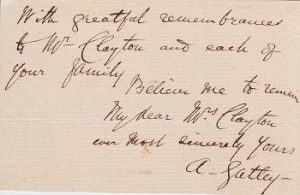 It reads – Believe me to remain Unfortunately there is no date, indeed, the body of the letter appears to have been cut off and discarded. While the Victorians tended to use over flowery text in their writings, it is possible that Mr & Mrs Clayton (probably of Kerridge) were patrons of Gatley and financially supporting him while he was failing to earn enough to live on, which was the case for most of his career.
|

Links
- https://www.geo.ed.ac.uk/scotgaz/features/featurefirst8582.html
- https://www.edinburgharchitecture.co.uk/craigentinny_marbles.htm
- Gawsworth Hall – Tudor Manor House with covered garden theatre
Reference:
Clicking the reference description takes you back to the text
Acknowledgements
Our thanks go to those who researched and discovered the history that is presented in these pages. Please read the full acknowledgement of their remarkable achievement. Unless otherwise noted, the historical pictures are from the Civic Society picture collection at the Discovery Centre and also available online.